
There is a strange magic in a piece of fabric that leaves its background empty. Most embroidery works hard to fill space with color, but the craft from the Umbrian hill town does the opposite. It stitches the negative space, leaving the motif hollow while the surrounding cloth glows with dense, deliberate thread. That contrast—the absence and the presence, the light and the dark—is what gives this needlework its timeless pull.
Visitors to the Basilica of San Francesco often pause in front of the altar cloths and wonder about the people who made them. The names are lost, the workshops long gone, but the technique survives in the hands of contemporary stitchers. This is the paradox of Assisi Embroidery: it is both a relic of a bygone era and a living practice that anyone can learn.
A name that points to a place with a complicated past
The craft takes its name from the town of Assisi, but the story is far from simple. The earliest known pieces date back to the thirteenth century, when convent workshops in central Italy produced ecclesiastical textiles. Nuns and monks worked by candlelight, creating liturgical garments that would vest priests and adorn altars. The motifs were largely geometric or drawn from nature, and the style was austere in a way that suited the Franciscan spirit of poverty and humility.
But the technique itself was already old when it reached Assisi. Similar shadow-work embroidery appeared in places far from Umbria, from the Balkan Peninsula to the Middle East. Scholars have debated whether the craft traveled westward with returning crusaders or arrived via the silk routes. Some historians point to a monastery on the Greek island of Chios, where a strikingly similar voided style was practiced. Others claim that the method evolved independently in Italian convents, a local answer to the desire for durable, reversible decoration on linen.
What is certain is that the town became a hub for the craft by the sixteenth century. A thriving guild system trained apprentices in the art, and the patterns developed a distinctly local character. The motifs became more narrative, often depicting scenes from the Bible or the lives of the saints. By the nineteenth century, visitors to Assisi could buy embroidered linens at the same market stalls that sold olive oil and wine, and the style had become synonymous with the town itself.
The great debate over who stitched those early pieces
For decades, historians operated on a cozy assumption: that the finest examples of the voided technique were the work of cloistered nuns. The story was romantic and neat. But a closer look at the documents from the era complicates the picture. Tax registers from the sixteenth century list embroiderers who were not members of any religious order. Some were men, which surprised scholars who had assumed the craft was exclusively female.
The commercial aspect is often overlooked. Embroidery charts and pattern books circulated across Europe, and workshops in Assisi shipped finished pieces as far away as Spain and England. These were not just devotional items but luxury goods. The workshops employed journeymen and apprentices in a system that had more in common with a modern factory than a quiet convent.
One particular piece now housed in the Victoria and Albert Museum in London shows an entirely different side of the craft. It is a cushion cover from the early eighteenth century, and its design features a pair of cherubs holding a garland of fruit and flowers. The stitching is immaculate, but the style is playful rather than reverent. It suggests that the craft had moved beyond the altar and into the world of domestic comfort.
What remains genuinely mysterious is the identity of the designers. No pattern book attributable to a named artist survives from the early period. The names of the stitchers are equally elusive. All that remains are the pieces themselves, and they are stubbornly silent about their creators.
What makes Assisi embroidery different from every other needlework style
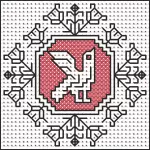
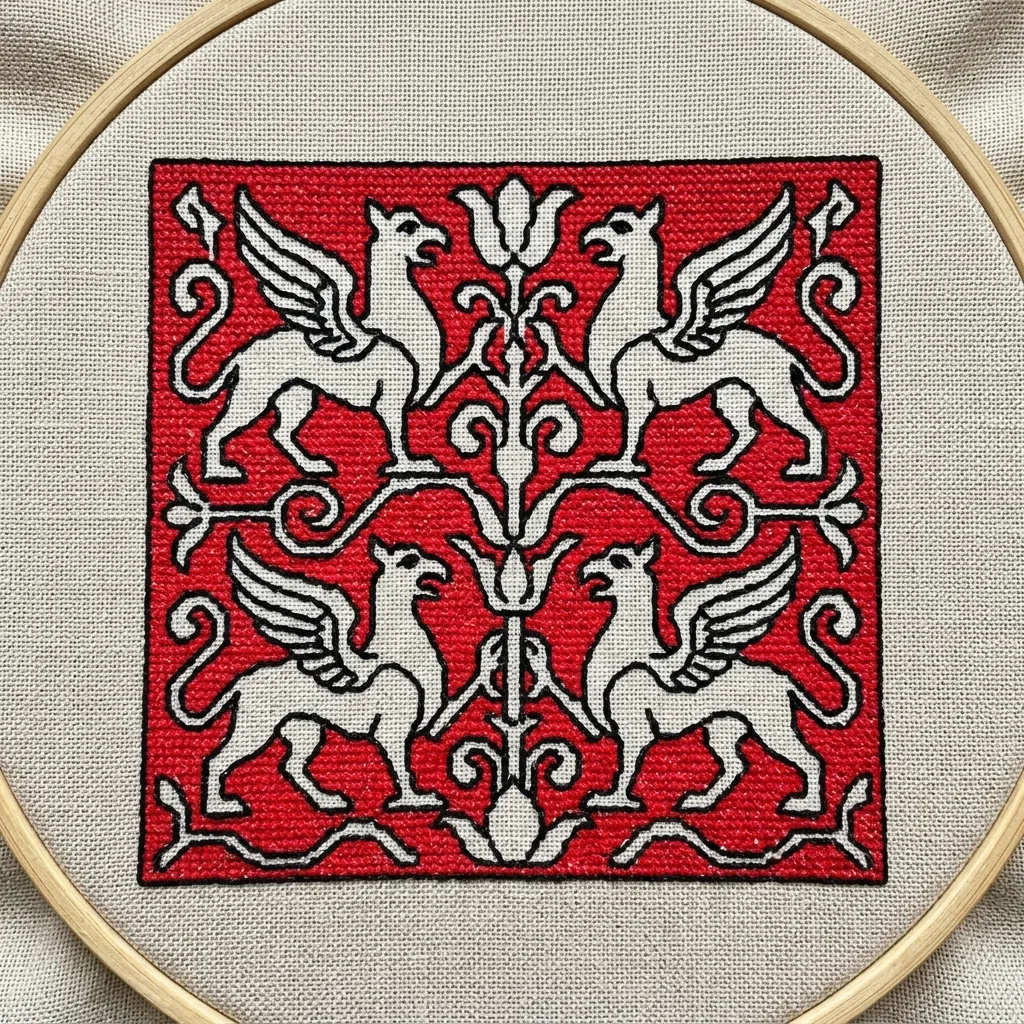
To the untrained eye, the style can be mistaken for cross stitch. But the differences are fundamental, not just cosmetic. The central motif, whether a bird, a flower, or a sacred symbol, is left completely bare. The background is filled with either a running stitch or a cross stitch, and the perimeter is framed by a decorative border. The effect is that of a silhouette cut out of the cloth, with the negative space doing the heavy lifting.
Historically, the earliest pieces used a running stitch that was reversible, which meant the back of the cloth looked nearly as finished as the front. This was a point of pride and a selling point. Clothes and linens might be turned inside out for display, so a clean back was worth the extra effort. Later pieces often used a diagonal stitch that covered the ground more quickly and allowed for more textured work, but the earlier reversible approach remains the gold standard for purists.
Another defining feature is the use of a single color for the background. Traditional pieces use a deep red or a rich blue, though brown and green appear in later examples. The unstitched motif then stands in sharp relief against this dense field of color. The choice of color was not arbitrary. Red symbolized martyrdom and was often used for religious themes, while blue represented the Virgin Mary and was favored for pieces intended for domestic use.
The border is not just decorative. It serves a practical purpose by anchoring the edges of the work and preventing the fabric from stretching out of shape. Most traditional pieces feature a repeating geometric or floral border that echoes the central motif. The border is often the part that distinguishes a masterwork from a mere amateur attempt, as even a small mistake becomes glaringly obvious in the repeated pattern.
The technique also requires a specific type of fabric. The cloth must be an evenweave linen, where the warp and weft threads are of identical thickness. This is non-negotiable. Embroidery floss on a loose weave will only frustrate you, and on a tight weave the threads will refuse to cooperate.
The symbols beneath the stitches
One of the most captivating aspects of the craft is its visual language. The motifs are not arbitrary decorations. They carry meaning, and for a contemporary stitcher, decoding those meanings adds a layer of satisfaction to the work.
Birds are perhaps the most popular subjects. They appear in conjunction with a tree of life, a symbol that predates Christianity and appears in many cultures across the world. In the context of Assisi embroidery, the tree and bird combination represents the soul’s connection to the divine. The bird is not trapped in the cage but perched in the branches, a symbol of freedom and spiritual release.
Flowers also play a significant role, and each type has its own specific meaning:
- The lily represents purity and was often used on pieces intended for young women.
- The rose symbolizes love and was present in both secular and religious compositions.
- The pomegranate, which is technically a fruit but appears in flower-like forms, represents resurrection due to its many seeds.
- The gillyflower or stock was a common motif with medicinal associations, included as a protective charm.
Animals beyond birds appear as well. The lamb represents sacrificial love and is frequently paired with a cross or a flag. The lion, often shown with its cubs, is a symbol of vigilance and strength. Some pieces even show mythical creatures like the griffin or the unicorn, which were popular in medieval bestiaries and carried their own complex meanings.
Geometric patterns also have a place in the repertoire. The diamond, the lozenge, and the twisted rope are repeated throughout the border designs. These shapes are older than the craft itself, with roots in Roman and Etruscan decorative art. Their presence in Assisi embroidery is a subtle nod to the culture that preceded the Franciscan order by hundreds of years.
The proverbs are the most fascinating part of the tradition for some modern practitioners. Many historical pieces carry a short motto or a line from scripture, stitched in the same voided style as the main motif. One famous example reads “Chi non spera quello che non ha, non avrà quello che desidera,” which translates to “Whoever does not hope for what they do not have will not have what they desire.” These inscriptions offer an intimate glimpse into the thoughts and feelings of the women who made them.
The practical tools of the craft
So you want to stitch an Assisi piece. Not just any embroidery, but this specific, centuries-old technique. The material list is short, but attention to quality matters more than volume.
| Material | Purpose | Recomendation |
|---|---|---|
| Evenweave linen | The base cloth | 25–28 count, look for 100% linen for true feel |
| Embroidery floss | The stitching thread | Use six-strand coton, separate and use two strands for cross stitch |
| Tapestry needle | The needle | Size 24 or 26, blunt tip slides through linen without splitting threads |
| Embroidery hoop | Stabilizes the fabric | 8-inch wooden hoop for manageable sections |
| Sharp scissors | To cut thread | Small, fine point to get close to the fabric |
When you are choosing a pattern, look for charts that mark the background with Xs and leave the central motif blank. Some charts do the opposite, and this can be confusing. The key is to remember that you are stitching at the background, not the subject. The motif is the void.
Before you begin, wash your hands and make sure your work surface is clean. Linen is unforgiving, and oils from your hands can leave permanent marks.
A step-by-step guide to your first piece
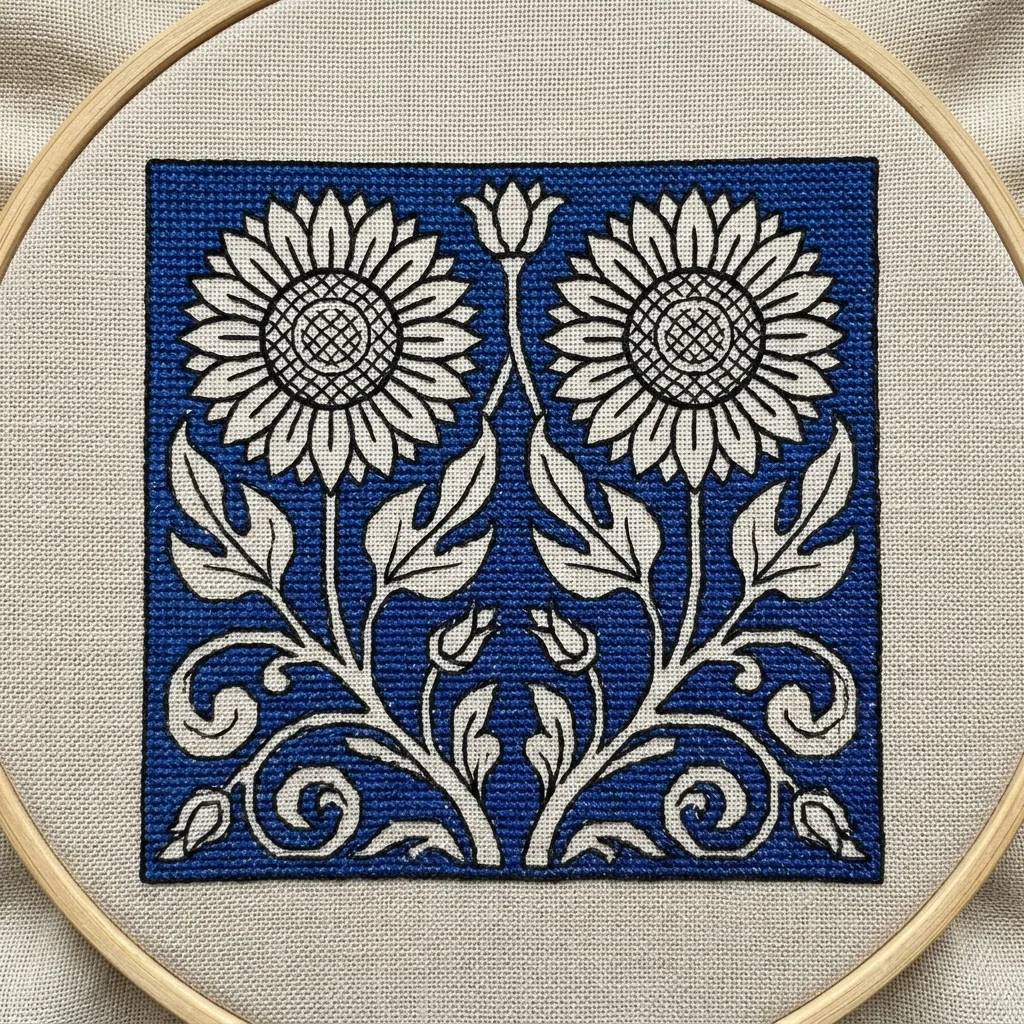
Let’s walk through a simple project from start to finish. We’ll stitch a small pouch with a sunflower motif, which is a classic pattern and forgiving for beginners.
First, prepare your linen. Cut a square of fabric, allowing an extra two inches on each side of your design. This margin gives you room to work and prevents the fabric from fraying at the edges. Baste the edges or use a zigzag stitch on a sewing machine to keep them from raveling.
Next, find the center of your fabric and the center of your chart. Fold the cloth into quarters and place a pin at the center. Start your stitching from that point, moving outward. This ensures that your design is properly centered and will not run off the edge of the cloth.
To fill the background, you will use the cross stitch. But here is a key difference from other cross-stitch projects: you will not cross your stitches immediately. Instead, you will work in diagonal rows. This is called the long-armed cross stitch method, and it creates a more uniform tension in your work.
- Bring the needle up at the bottom left corner of your first square.
- Take it down at the top right, then bring it up at the bottom right.
- Take it down at the top left, completing one full cross.
- For the next stitch, bring the needle up at the bottom left of the adjacent square and repeat.
Work in rows from left to right and from right to left, and the back of your work will show a clean vertical line instead of a jumble of knots. This is the reversible quality that traditional stitchers prized.
When you encounter the central motif, simply do not stitch it. The contrast between the filled background and the empty motif will grow more dramatic as you progress. Some stitchers are tempted to backstitch around the motif to define its edges. This is a modern addition and is not part of the traditional technique. If you want an authentic finish, resist the temptation.
Work in sections of about ten square inches at a time. This prevents the finished stitches from being crushed by the hoop and maintains an even tension across the piece.
When you finish, rinse the embroidery in lukewarm water with a drop of mild soap, then roll it in a towel to remove excess moisture. Iron it face down on a clean white cloth, using a medium heat. This will set the stitches and give the piece a professionally finished look.
The special case of the Assisi stitch proper
The older, reversible style deserves its own mention. It is called the Assisi stitch, and it differs from the cross stitch in both its appearance and its execution.
The stitch covers the ground with a pattern of close, resemblance blocks that look like woven bands rather than individual crosses. It is worked in two passes. The first pass covers the background in a series of long diagonal lines, and the second pass fills in the spaces with short connecting stitches. The result is a smooth, dense texture that closely resembles tapestry.
This stitch is slower than cross stitch, but the finished surface is worth the time. It is especially well suited to pieces with large areas of background or to borders that repeat a dense pattern.
When working the Assisi stitch, the fabric must be held very taut. A rotating hoop with a stand is helpful, as it allows you to keep both hands on the needle and maintain even tension. The thread should be kept short, about 18 inches, to prevent fraying from repeated passes through the fabric.
The practical advice here is this: if you are a beginner, master the cross stitch version first. The Assisi stitch can wait for your second project, when you have a feel for the tension and rhythm of the craft.
The modern revival and how designers keep the craft alive
There was a time when the craft seemed doomed to extinction. By the late twentieth century, fewer and fewer descendants of the old workshops had any interest in the slow, meticulous work. Machine embroidery had replaced the handwork in all but the most exclusive boutiques, and the knowledge was passing with elderly women who had learned the skill from their own mothers.
But the internet changed the equation. A new generation of needlewomen and needlemen discovered the craft through social media and online forums. The visual appeal is immediate, as the stark contrast of a geometric motif against a deep red or blue background photographs beautifully and does not fade in a flat image.
Contemporary designers have adapted the old motifs to modern tastes. The traditional birds and flowers remain popular, but they are now joined by abstract forms, geometric patterns, and even pop culture icons. One designer in Turin sells charts of vintage motorcycles, stitched in the traditional voided style with deep blue thread on natural linen. It is a world away from the medieval altar cloths, yet it carries the same DNA.
The market for historical reproductions is also thriving. Museums across Europe have commissioned replicas of their most treasured pieces for educational purposes, and a few skilled stitchers have made this their specialty. One such artist in Rome gained a following for her faithful reproductions of sixteenth-century ecclesiastical garments. She spends up to two years on a single piece, using period-appropriate linen and silk threads that she dyes by hand.
For the average stitcher, the allure is not authenticity but connection. Each piece takes dozens of hours, hours that are quiet, meditative, and still. There is a particular joy in re-creating a design that was first worked by a woman four hundred years ago, to feel the same rhythm of the needle and to understand her patience.
Choosing colors and materials in the modern era
You are not bound by tradition when you start stitching today. The freedom to choose modern materials is one of the pleasures of the craft.
For a contemporary look, many stitchers choose a natural undyed linen and use a vibrant, unconventional thread color. Mustard yellow, sage green, and terracotta all work beautifully against the neutral fabric. For a more traditional effect, the deep red and midnight blue are the classics, and it is easy to see why they have endured. These colors recede slightly, allowing the unstitched motif to come forward as the visual focus.
The fabric count affects the scale of your finished piece. A 28-count linen will give you a smaller, more delicate result than an 18-count. If you are working from a chart that was designed for a specific count, you will need to adjust the size of your finished piece or the amount of fabric you purchase.
The thread type matters too. Traditional pieces used a matte cotton floss that soaked up the light rather than reflecting it. For an authentic look, avoid any thread with a shiny finish. Pure cotton, not mercerized, is the best choice. Silk is also traditional and gives a beautiful, subtle luster, but it is more slippery and requires practice to handle smoothly.
Common pitfalls for beginners and how to avoid them
The learning curve is not steep, but there are a few traps that catch most new stitchers.
The most common mistake is pulling the thread too tightly. The finished piece should have a smooth, even surface, and that is impossible if your cross stitches are cinched and distorting the fabric. Always give the thread a gentle shake before you take the needle down, so you leave a little slack.
A second common error is starting in the wrong place. Many amateur pieces end up with a border that does not match up at the corners because the stitcher began at the edge of the design rather than at the center. The center is the anchor point, and everything else builds outward from it.
The third error is less obvious but equally damaging: the use of a hoop that is too large. When you are working on a piece that is smaller than the hoop, you cannot see the design all at once, and it is easy to misplace a stitch. Choose a hoop that fits the section you are working on with little excess fabric visible.
Finally, do not be afraid to take out stitches that you do not like. Weaving in a mistake and leaving it will only bother you every time you look at the finished piece. It is faster to remove and redo a few rows than to learn to live with a flaw.
Where to find patterns and community
The internet has made it easier than ever to access charts and instructions. Etsy has a lively marketplace for vintage and modern Assisi embroidery patterns, many of which are delivered as instant PDF downloads. A search for digital files will yield dozens of options, from the traditional bird-and-tree motif to the modern and quirky.
Libraries are another, often overlooked resource. Many public libraries have collections of needlework books, and the larger institutions carry rare books on European folk art that include patterns from the early twentieth century. These are a wonderful source if you want to work with authentically historical designs.
Local guilds and stitching groups often have members with a specialization in this style. Contacting a guild in advance can put you in touch with a mentor, someone who has spent decades at the craft and has the answers you will not find in a book.
If you prefer to work alone, online video tutorials are a practical alternative to a live teacher. Seeing the needle in motion is helpful for understanding the diagonal line of the long-armed cross stitch. The slow, close-up filming demonstrates the technique well.
It is also possible to design your own chart, and this can be a deeply satisfying part of the craft. Simple line art works best. Convert a simple outline drawing into a grid pattern, and you have your own pattern to stitch. Free conversion software is available online, and it is not hard once you understand the basic principle of translating an image into a grid of squares.
A visit to the source of the craft
If you ever find yourself in Italy, the town of Assisi is a pilgrimage site for more than just religious reasons. The Museum of the Basilica houses one of the finest collections of historical needlework pieces. Seeing the objects up close, after studying photographs, is a revelation. The photographs flatten the texture, but in person you can see the individual threads and the subtle unevenness of the hand-made work.
Tourists who bring a hand-stitched piece to Assisi often find a surprising welcome. The local residents have a deep affection for the craft, and a few of the older women still embroider in the traditional style, selling pieces at the Sunday market. There is a particular kind of social transaction when you show them your own work, a common language through the shared rhythm of the needle.
The town also hosts occasional workshops and classes during the summer months, often taught by the last remaining professional embroiderers in the region. These classes fill up quickly, so it is best to book months in advance if you want a seat.
The value of slow work
There is a reason that the craft has survived extinction while faster forms of needlework have come and gone. The process itself is a form of prayer, even for those who are not religious. The repetitive motion of the needle, coupled with the quiet focus required to keep the tension even, settles the mind in a way that is difficult to replicate in any other activity.
Each of us who stitches today is part of a line that stretches back centuries, a chain of hands and eyes and patience that has never been entirely broken. The designs have changed, the colors have shifted, but the fundamental act is the same: taking a single thread and a single needle and making order from a blank piece of cloth.
The mystery of the unnamed craftspeople will never be solved. Their names are gone, their melodies are silent. But their work remains, and each of us, with our own hands and our own thread, adds another link to a chain that spans time. Stitch by stitch, we keep the story alive, even as the hands that originally told it have long since turned to dust.
See also Blackwork and Redwork